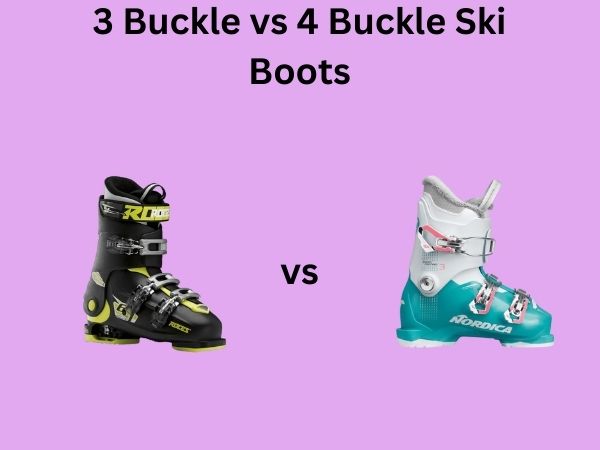
3 Buckle vs 4 Buckle Ski Boots: The Complete Fit, Control & Comfort Comparison Guide
When you’re standing in a ski shop trying to decide which boots to take home, you might find yourself staring at two pairs that look almost identical—except one has three buckles and the other has four. It’s easy to think that the difference is minor, but trust me, it’s far more significant than you might realize. The buckle count on your ski boots isn’t just a cosmetic choice; it fundamentally affects how your feet perform on the mountain, how comfortable you’ll be after a full day of skiing, and ultimately whether you’ll enjoy your time on the slopes or spend it wincing in pain.
I’ve spent considerable time testing both styles, and I want to walk you through everything you need to know to make an informed decision. Whether you’re a beginner taking your first lessons or an experienced skier upgrading your gear, understanding the real differences between 3 buckle and 4 buckle boots will help you choose the right equipment for your needs.
Understanding Ski Boot Buckle Systems
Before we dive into the specifics of three versus four buckles, let’s talk about what these buckles actually do. Think of ski boot buckles as the security system for your foot. They’re not just there for show—they’re the mechanism that keeps your foot locked in place within the boot’s shell. When you buckle your ski boots, you’re creating multiple points of contact that work together to keep your heel from lifting, your foot from sliding, and your leg properly aligned with your skis.
The buckle system is particularly important because skiing demands precision. Your skis respond to subtle weight shifts and edge angles, and if your foot is moving around inside your boot, you lose that direct connection. It’s the difference between playing a violin with a tightly held bow and trying to play with a loose grip—the control just isn’t there.
How Buckles Work in Modern Ski Boots
Modern ski boot buckles operate on a straightforward principle. They clamp down on the boot’s shell using a lever or ratcheting mechanism, applying pressure at specific heights on your foot and ankle. The higher the buckle, the more control it has over your upper foot and lower leg. The lower buckles focus on securing your midfoot and arch area. This vertical distribution of pressure points is where the whole three versus four buckle debate becomes interesting.
What Are 3 Buckle Ski Boots?
Three buckle ski boots have been around for decades, and they’ve proven themselves as reliable, functional equipment for countless skiers. These boots typically feature buckles positioned at the ankle, lower calf, and upper calf areas. If you imagine your leg from the knee down, the buckles are spaced roughly evenly to create support at three strategic points.
The Design Philosophy Behind 3 Buckle Systems
Three buckle boots represent a minimalist approach to boot design. Manufacturers chose this configuration because it provides adequate support for most skiers while keeping the boot lighter and more affordable. The thinking is that three well-positioned contact points can effectively secure your foot without the added bulk and expense of a fourth buckle.
These boots are often the standard choice for recreational skiers, ski schools, and rental shops. That prevalence means they’ve been extensively tested and refined over many seasons. When something works reasonably well and is cost-effective, it tends to stick around.
Advantages of the 3 Buckle Design
- Lighter weight compared to 4 buckle models
- Lower price point makes them accessible to more skiers
- Simpler buckle system is easier to operate quickly
- Proven track record spanning decades
- Adequate support for intermediate-level skiers
- Less potential for over-tightening in the upper calf
What Are 4 Buckle Ski Boots?
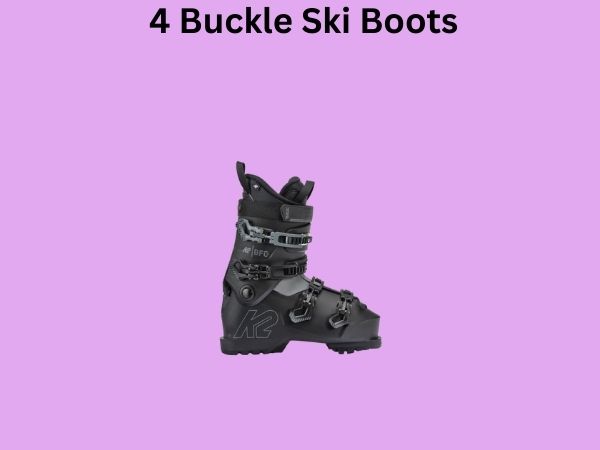
Four buckle ski boots represent the premium approach to boot design. These boots add an additional buckle, typically positioned in the upper calf area, creating four distinct contact points along your foot and lower leg. This extra buckle might seem like a small addition, but it fundamentally changes how the boot distributes pressure and controls your movement.
The Engineering Behind 4 Buckle Systems
Adding a fourth buckle requires more sophisticated boot shell design and construction. The manufacturers need to create additional attachment points on the shell while maintaining structural integrity. They also need to engineer the buckle mechanism to work in harmony with the other three, ensuring that tightening one doesn’t create uncomfortable pressure points elsewhere.
Four buckle boots are typically found in intermediate to advanced ski boots. They’re the choice of skiers who spend significant time on the mountain and want maximum control and responsiveness. You’ll see them on aggressive freeriders, technical skiers, and anyone who’s invested heavily in their skiing performance.
Advantages of the 4 Buckle Design
- Superior ankle and lower leg support and control
- Better power transmission from leg to skis
- More precise buckle adjustment options
- Reduced heel lift during aggressive skiing
- Better weight distribution across the buckle system
- Enhanced stability during challenging terrain
- Improved performance for skiers with higher calf volumes
Fit and Sizing Differences
This is where the differences really start to matter in a practical sense. When you’re trying on ski boots, the number of buckles affects how the boot wraps around your leg and distributes pressure.
3 Buckle Boot Fit Characteristics
Three buckle boots tend to have a more forgiving fit in the calf area. With fewer contact points, there’s more flexibility in how tightly the boot can grip your leg. This is actually beneficial if you have slimmer calves or if you’re dealing with the common problem of having one calf slightly larger than the other. The three buckles can accommodate a wider range of calf sizes without creating uncomfortable pressure points.
The trade-off is that if you have a larger calf, a three buckle boot might not provide enough compression, leading to heel lift and reduced control. You might find yourself struggling to get the boot tight enough at the upper calf without over-tightening the lower buckles.
4 Buckle Boot Fit Characteristics
Four buckle boots offer more granular control over how snugly the boot fits at each level. If your calf is particularly muscular or full, you can tighten the upper buckles while keeping the lower buckles at a comfortable tension. This customization is invaluable for achieving that perfect balance between security and comfort.
The additional buckle creates a more rigid system overall. Some skiers appreciate this firm, locked-in feeling. Others find it takes some getting used to, especially if they’re accustomed to the slightly more flexible calf area of a three buckle boot.
Toe Box and Heel Pocket Fit
Here’s something important to note: the buckle count doesn’t directly affect toe box or heel pocket fit. These are determined by the overall boot shape, volume, and shell sizing. Both three and four buckle boots come in various widths and volumes, so you need to focus on the boot’s fundamental fit, not just the buckle count.
Comparing Ankle Support and Control
This is perhaps the most significant practical difference between the two systems. Ankle support isn’t just about comfort; it directly influences your ability to control your skis precisely.
Ankle Support in 3 Buckle Boots
Three buckle boots provide adequate ankle support for most recreational and intermediate skiers. The buckle positioned at ankle level secures your foot effectively. However, there’s a limit to how much control you can achieve with this configuration. If you’re making quick, aggressive turns or skiing challenging terrain, you might notice a slight feeling of movement in your ankle area.
Think of it like this: a three buckle boot is like having three strong ropes tying your foot to the boot’s shell. They work, and they work reasonably well, but there’s still some play in the system.
Ankle Support in 4 Buckle Boots
Four buckle boots provide noticeably superior ankle support. The additional buckle in the upper calf area works in conjunction with the ankle buckle to create a more rigid structure that resists any movement. The extra contact point means pressure is distributed more evenly, and your ankle has less opportunity to rotate or shift within the boot.
For advanced skiers pushing their limits, this extra control is transformative. It allows for more precise edge control and better response to subtle technique adjustments. When you’re carving hard through moguls or skiing steep terrain at speed, that extra security is genuinely valuable.
Power Transmission and Responsiveness
Power transmission is a term you’ll hear in skiing circles, and it refers to how directly your leg movements translate into ski movements. A more secure boot means less energy is wasted on internal movement. With four buckles, your leg and ski are more directly connected, so your efforts to control the ski are more efficiently transferred to the actual ski edges.
Comfort Level Analysis
Here’s where things get nuanced because comfort is incredibly personal. What feels great to one skier might feel restrictive to another.
3 Buckle Boot Comfort
Many skiers find three buckle boots more comfortable for extended periods. The fewer buckles mean fewer pressure points, and the slightly more flexible calf area feels less constricting. If you have sensitive skin or are prone to pressure-related discomfort, three buckle boots might be your better choice.
The downside is that to achieve adequate support, you might need to buckle them tighter, which can paradoxically reduce comfort. You’re essentially trying to get maximum security from fewer contact points, which puts more pressure on each individual buckle.
4 Buckle Boot Comfort
Four buckle boots can distribute pressure more evenly across more contact points. In theory, this should allow you to tighten them effectively for support without needing to crank any individual buckle super tight. Many skiers report that four buckle boots feel more comfortable because they can achieve security without that vice-like clamping sensation.
However, if a four buckle boot doesn’t fit your foot perfectly, those extra buckles can become extra pressure points working against you. So comfort with four buckle boots really depends on getting the right fit.
Break-In Period Considerations
Three buckle boots generally have a shorter break-in period because there’s less going on structurally. Four buckle boots might take a bit longer to break in properly as you learn to adjust all four buckles optimally. Don’t make the mistake of assuming that tightening all four buckles equally is the right approach—each one might need different tension depending on the boot’s fit on your leg.
Performance on Different Terrain
The type of skiing you do matters significantly when choosing between these two systems.
Groomed Runs and Carving
On well-groomed, predictable terrain, both three and four buckle boots perform admirably. If you’re primarily a groomer-carver who likes smooth, clean turns on prepared slopes, you won’t see a dramatic difference in performance. A quality three buckle boot will do everything you need.
Variable Terrain and Off-Piste
Once you venture into variable snow conditions, moguls, or off-piste terrain, the advantages of four buckle boots become more apparent. The additional support helps you maintain control when the snow is unpredictable. Your ankle stays more secure, and you have better responsiveness when you need to make quick adjustments.
High-Speed Skiing and Aggressive Techniques
If you’re regularly skiing at high speeds or performing aggressive techniques, four buckle boots give you noticeably better control and confidence. The additional security means you can push harder without worrying about your foot shifting within the boot. This is where recreational skiers notice the biggest performance difference if they upgrade to four buckle boots.
Buckle Adjustment and Customization
How you adjust your buckles is actually more important than the buckle count itself, yet many skiers never really think about it strategically.
Adjustment Strategy for 3 Buckle Boots
With three buckles, you need to find the right tension balance. The lower buckles should be snug but not aggressive—you’re aiming for enough pressure to keep your foot from sliding but not so much that you’re cutting off circulation. The upper buckle, being at the ankle, is typically buckled tighter because this is your primary control point.
The challenge is that if your lower buckles aren’t tight enough, tightening the upper buckle won’t fix the problem. You need all three working together in harmony.
Adjustment Strategy for 4 Buckle Boots
Four buckle boots give you more flexibility. You can adjust the upper and lower calf buckles independently, which is particularly useful if your calf tapers significantly from top to bottom. Many skiers find they can actually use lighter tension overall because the four buckles together achieve the security that three buckles required with tighter individual tension.
Finding Your Personal Sweet Spot
Regardless of buckle count, the goal is never to buckle your boots so tight that they’re uncomfortable. A properly fitted boot that’s snug but not painful will outperform an over-tightened boot any day. Some skiers make the mistake of assuming tighter equals better, but that’s not true. Over-tightening actually reduces comfort and can impair your circulation, which hurts performance.
Durability and Maintenance
Are four buckle boots more prone to breaking because they have more components? Let’s address this directly.
Buckle Durability in 3 Buckle Systems
Three buckle boots have fewer buckles to potentially fail, which is straightforward logic. If one buckle breaks, you’re left with two. The simplicity of the system also means fewer parts are interacting, reducing the chance of one failure cascading into a bigger problem.
Buckle Durability in 4 Buckle Systems
Modern four buckle boots are engineered to be just as durable as three buckle boots. The additional buckle isn’t a weakness; it’s an additional component that’s been designed with durability in mind. Quality manufacturers use the same durable materials and construction techniques for the fourth buckle as they do for the other three.
In my experience, boot failure is far more likely to come from general wear and tear on the shell or internal boot padding than from buckle failure, regardless of the buckle count. A broken buckle is genuinely rare with modern boots from reputable manufacturers.