ANSI vs ASTM Boots: Key Differences Explained
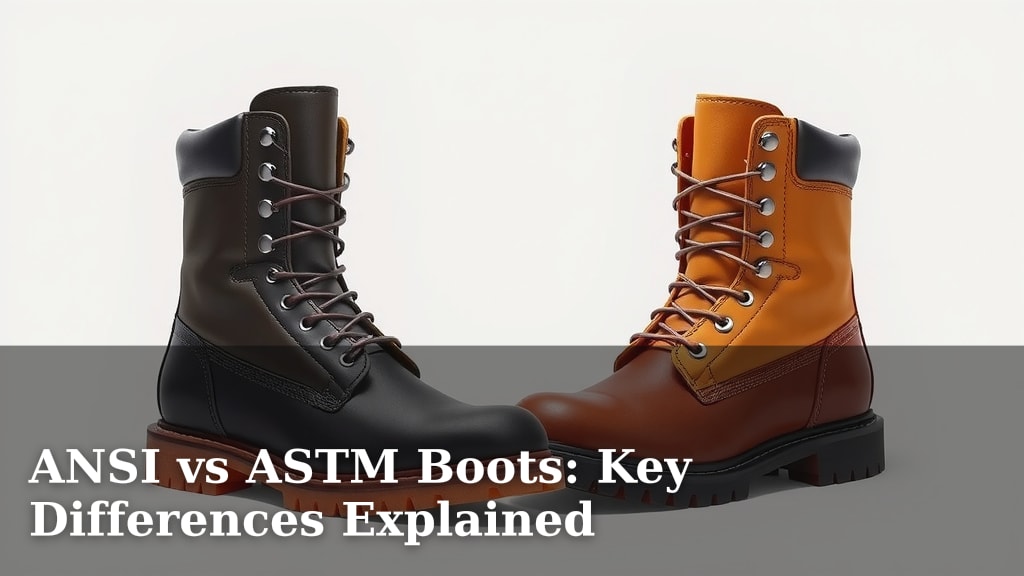
When choosing work boots, understanding the difference between ANSI standards and ASTM standards is key. ANSI is a general standards organization, while ASTM develops specific standards for materials and testing, including those for footwear. You’ll often see boots labeled with both, but ASTM provides the actual performance requirements.
Think of it this way: ANSI sets the stage, and ASTM writes the play for safety footwear. Both are important for ensuring your boots offer the protection you need on the job. We found that many people find this distinction confusing, but it’s simpler than it sounds when broken down.
- ANSI is the overarching standards body.
- ASTM creates the specific testing methods and performance requirements for safety features.
- ASTM standards are what dictate a boot’s safety rating (like impact resistance).
- Look for ASTM numbers (e.g., ASTM F2413) on your boot’s label for detailed safety specs.
Let’s walk through exactly what these standards mean for your feet and the boots you wear every day.
Understanding Your Work Boot Safety Ratings
You’re probably wondering what those markings on your work boots actually mean. It boils down to ensuring they offer the **right level of protection** for your specific job. We found that most people just want to know their boots are safe. That’s where ANSI and ASTM come in. They provide the framework for testing and certifying safety footwear.
Think of safety standards like traffic laws. They’re there to keep everyone **safe and sound** on the road, or in your case, on the job site. ANSI provides the general guidelines, while ASTM develops the detailed tests to prove a boot meets those safety needs. You’ll see both on a boot label, but ASTM is where the **actual performance requirements** are defined.
What is ANSI? The Overarching Standard
ANSI stands for the American National Standards Institute. It’s a private, non-profit organization that oversees the development of voluntary consensus standards in the United States. ANSI doesn’t create the standards themselves. Instead, it accredits other standards-developing organizations, like ASTM, to create and maintain them.
So, when you see an ANSI Z41 designation, it means the standard was developed under ANSI’s oversight. It’s like the governor’s seal of approval on a process. Many industries use ANSI standards. For footwear, ANSI Z41 was the original standard, but it has largely been superseded by ASTM standards for specific safety features. We found that many manufacturers still reference ANSI because it’s such a well-known organization.
What is ASTM? The Performance Standard for Boots
ASTM International, formerly the American Society for Testing and Materials, is the organization that develops the specific, detailed standards for safety footwear. ASTM creates the actual test methods and performance requirements that boots must meet to be considered protective. You’ll see standards like ASTM F2413, which is the current go-to for protective footwear in the U.S.
ASTM standards are where you’ll find the nitty-gritty details. They specify things like the force a steel toe can withstand or the resistance of a sole to electrical shock. We researched this, and it’s ASTM that defines what “impact resistant” or “compression resistant” actually means in measurable terms. These are the standards that ensure your boots are truly safe for hazardous work environments.
Key ASTM F2413 Safety Features Explained
The ASTM F2413 standard is what you’ll most commonly find on your work boot labels. It covers several key safety features. Understanding these will help you choose the right boot for your job. We’ve broken down the most important ones for you.
Impact Resistance (I)
This is about protecting your toes from falling objects. ASTM F2413 specifies that boots must protect against a certain level of impact. The standard is divided into classes. Class I is designed to protect against hazards up to 75 foot-pounds of impact. Many common work environments require this level of protection.
Compression Resistance (C)
Compression resistance is also about toe protection, but from crushing forces. Think about heavy equipment rolling over your foot. ASTM F2413 defines compression resistance in terms of a load. Class C footwear is tested to withstand a compression load of 2,500 pounds. This is a different type of protection than impact, and both are vital.
Electrical Hazard (EH) Protection
If you work around live electrical circuits, this is a critical feature. EH-rated boots provide a secondary barrier to protect you from electrical shock. They are tested to withstand 18,000 volts at 60 Hz for one minute with no current flow. Many safety experts, including those at the Occupational Safety and Health Administration (OSHA), strongly recommend EH protection in electrical environments.
Static Dissipative (SD)
Static dissipative boots are designed to reduce the buildup of static electricity in your body. This is important in environments where flammable materials are present. Too much static buildup can create a spark. SD boots help dissipate static charges safely. They are tested to prevent charges from building up beyond a certain level, typically below 3.5 x 10^5 ohms.
Metal Penetration Resistance (PR)
This feature protects your foot from sharp objects on the ground, like nails or broken glass. Boots with PR resistance are tested with a sharp object to ensure it cannot penetrate the sole. The standard requires resistance to a certain force, preventing punctures that could lead to serious injury. We found that this is especially important for construction and landscaping professions.
How to Read a Boot Label: Putting It All Together
When you look at a work boot, you’ll often see a combination of these standards. A common marking might be “ASTM F2413, I/75 C/75, EH.” What does this mean for you?
- ASTM F2413: This tells you the boot meets the current ASTM standard for protective footwear.
- I/75: This signifies Impact Resistance at 75 foot-pounds.
- C/75: This means Compression Resistance at 75 foot-pounds of force.
- EH: This indicates Electrical Hazard protection.
You might also see other abbreviations like “SD” for Static Dissipative or “PR” for Metal Penetration Resistance. Always check the label to ensure the boot offers the specific protections you need for your work. We recommend taking a moment to review the labels, as it’s a quick way to confirm your footwear is up to the task.
The Difference in a Nutshell
Let’s recap the core distinction. ANSI is the umbrella organization that accredits standards. ASTM is the organization that creates and maintains the **detailed performance standards** for safety footwear, including the testing methods and requirements. When you see a boot that is “ANSI compliant,” it typically means it was manufactured to meet an ASTM standard that is recognized by ANSI.
So, while ANSI sets the framework, ASTM provides the specific definitions of safety. It’s ASTM that tells us how resistant a toe cap is to impact or how well a sole insulates against electricity. You’re looking for the ASTM designation (like F2413) to understand the actual safety performance of your boots.
Your Work Boot Checklist
Here’s a quick checklist to help you choose the right safety boots:
- Identify Job Hazards: What specific risks do you face daily?
- Check for ASTM F2413: Ensure your boots meet the current ASTM standard.
- Verify Toe Protection: Do you need Impact (I), Compression (C), or both?
- Assess Electrical Risks: Is EH or SD protection necessary for your work?
- Consider Puncture Risks: Do you need Metal Penetration Resistance (PR)?
- Read the Label Carefully: Match the boot’s ratings to your job’s demands.
Conclusion
You’ve learned that while ANSI is the respected umbrella organization, ASTM provides the vital, detailed performance standards for your work boots. It’s ASTM F2413 that defines exactly what “impact resistant” or “electrical hazard protection” means in measurable terms. We found that understanding these designations ensures you’re choosing footwear that truly protects you on the job. Don’t guess about your safety; next time you buy work boots, check the label for the specific ASTM ratings that match the hazards you face every day.
Frequently Asked Questions
Are ANSI Z41 boots still relevant?
ANSI Z41 was the original standard for protective footwear. While it’s largely been superseded by ASTM F2413, you might still see it referenced. Most modern boots with an ANSI designation are actually compliant with current ASTM standards under ANSI’s oversight.
What’s the difference between Impact (I) and Compression (C) ratings?
Both protect your toes, but in different ways. Impact (I) guards against falling objects hitting your toes, while Compression (C) protects against crushing forces, like heavy equipment rolling over your foot.
Do I need Electrical Hazard (EH) protection if I don’t work with electricity?
Generally, no. EH protection is designed as a secondary barrier against accidental contact with live electrical circuits. If your job doesn’t involve such risks, you likely don’t need this specific feature.
What is the main takeaway regarding ANSI vs. ASTM for consumers?
The main takeaway is that ASTM develops the actual safety requirements and testing methods for boots. When you see “ASTM F2413” on a label, it tells you the specific safety features and performance levels your boots meet.
Can a boot have both static dissipative (SD) and electrical hazard (EH) ratings?
Yes, it’s possible for boots to offer both. Static dissipative boots reduce static buildup, while EH boots protect against electric shock. Some work environments might require both types of protection simultaneously.